
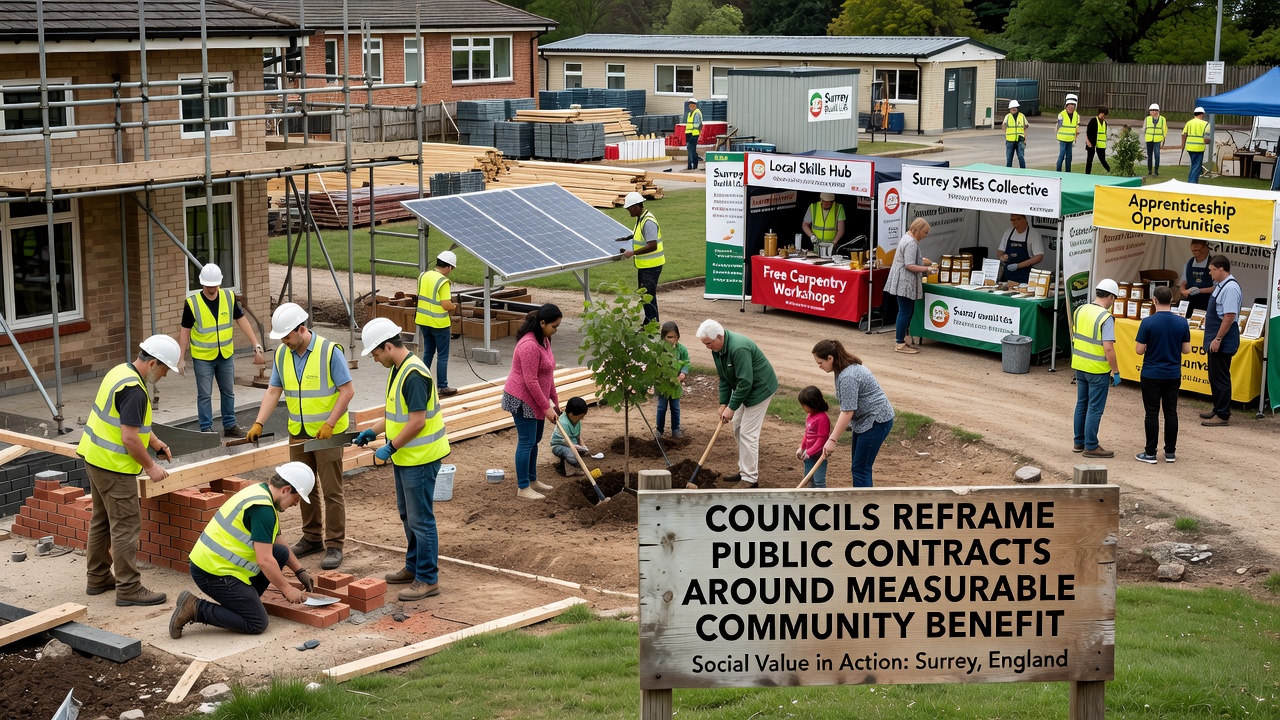
Public bodies across the country are rethinking what a contract is actually meant to deliver. Beyond the invoice and the service specification, local authorities increasingly expect suppliers and partners to generate measurable benefit for the people living in the area - a concept now formalised under the term social value. In Surrey, this shift is being presented not as an abstract policy aspiration but as a practical framework for how business is done with the public sector.
What Social Value Actually Means in Practice
Social value refers to the additional benefit created in a community that sits outside the core deliverable of a contract or day-to-day operation. A construction firm building a school, for instance, might also commit to local apprenticeships. A facilities provider might support community volunteering schemes or reduce its environmental footprint beyond regulatory minimums. The principle covers three interlocking strands: social wellbeing, economic opportunity, and environmental sustainability. None of these are new ideas individually, but formalising them into procurement and partnership decisions changes how organisations compete for and deliver public work.
Why This Matters to Local Economies
Embedding social value into contracts changes supplier behaviour at scale. When public bodies weigh social and environmental contribution alongside price and quality, bidders have a direct incentive to invest in local labour markets, skills training, and community infrastructure rather than treating these as optional extras. This matters particularly for small and medium-sized enterprises, which often have stronger local roots than larger contractors but have historically struggled to compete on price alone. A social value framework can level that competition, provided it is assessed consistently and not reduced to a box-ticking exercise.
The Marketplace Model and Its Limits
Surrey's approach includes a marketplace where organisations can post requests and offers - connecting businesses, charities, and public bodies directly rather than relying solely on formal procurement rounds. This has genuine value: it surfaces smaller, informal opportunities for contribution that a traditional tender process would never capture, from equipment donations to volunteer time. The risk is dilution. Without clear measurement and follow-through, social value commitments can become marketing statements rather than delivered outcomes. Councils and partner organisations need consistent reporting standards to ensure pledges translate into verifiable community impact, not simply goodwill attached to a press release.
What Comes Next
The direction of travel across UK public procurement has been toward greater weighting for social value in contract award criteria, and Surrey's model reflects that broader trend. For businesses, this means social contribution is no longer a reputational add-on but an increasingly material factor in winning public work. For residents and community organisations, the test will be whether promised value - jobs created, environmental improvements made, local spending retained - is actually tracked and reported transparently over the life of a contract, rather than announced once and left unmeasured.