
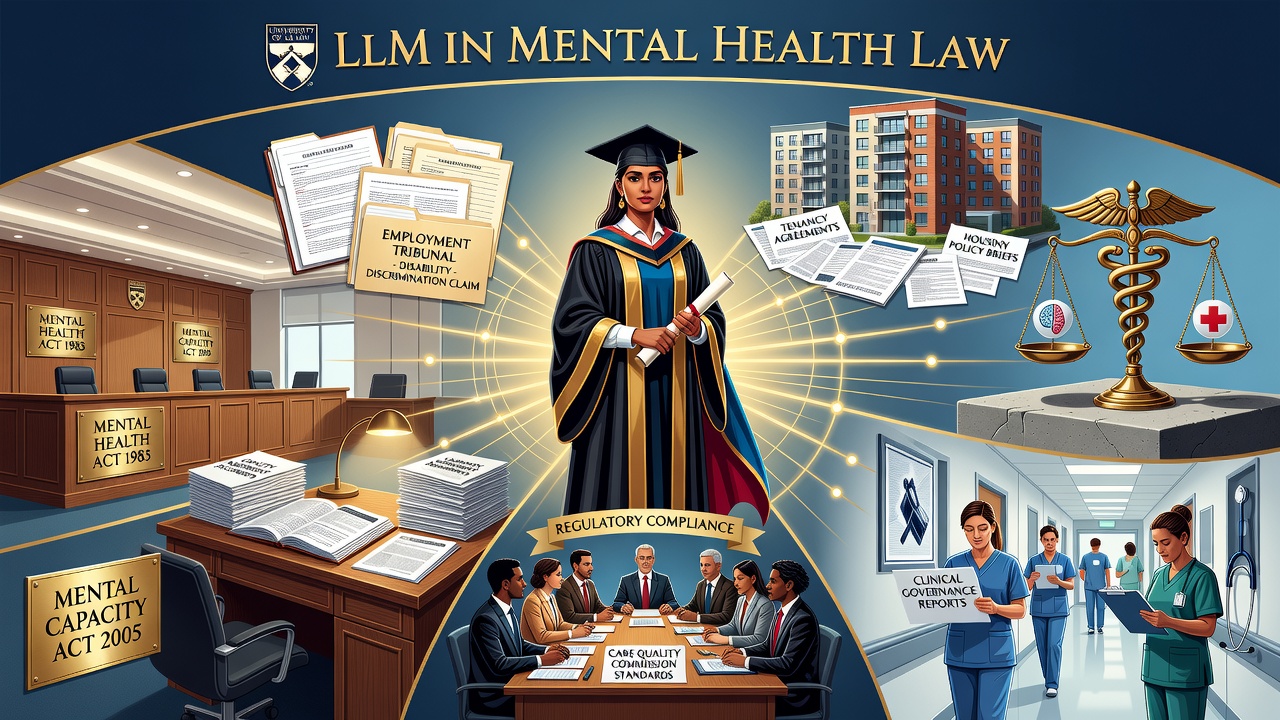
Mental health law now touches housing policy, employment disputes, criminal proceedings, clinical governance and the regulation of care services - a reach few areas of law can claim. The University of Law's LLM in Mental Health Law is built around that breadth, training graduates to work across sectors where legal rights and psychiatric care intersect. It is aimed at both law and non-law graduates looking to specialise in a field that sits at the junction of statute, medicine and social policy.
Why the Subject Cuts Across So Many Fields
Mental health law is unusual in how widely it is applied. It governs detention and treatment decisions under the Mental Health Act, informs capacity assessments under the Mental Capacity Act, and shapes disputes that reach the Court of Protection. It also intersects with employment law, civil litigation, clinical negligence claims and personal injury cases. The course reflects this by covering housing, criminal and civil law interactions, and the regulation of mental health services alongside the core statutory frameworks. For graduates, this translates into a qualification relevant to medico-legal practice, healthcare management, policy work, regulation and bioethics - not solely courtroom advocacy.
How the Course Is Structured
Full-time students complete the course across three semesters in twelve months; part-time students spread the same content over six semesters across two years. Both routes begin with compulsory study of Mental Health Law and Research Methods Training, alongside elective modules chosen from the available guide at each study location. Students on certain pathways also take a module from the Healthcare Centre of Excellence. The final stage is either a 15,000-word dissertation in Mental Health Law or, on some pathways, a Professional Research Project combined with an additional elective module. Non-law graduates complete a compulsory two-week induction on the Key Principles of the English Legal System, which is also open to law graduates returning after a break from formal study.
Assessment and Delivery Formats
Taught modules are assessed either through a three-hour unseen written examination or a 4,500-word coursework assignment, depending on the module. The dissertation route demands sustained, independent research into a chosen area of mental health law. Delivery format varies: online students attend two-hour live workshops supported by preparatory materials, while Online Self-Guided students follow a flexible, self-directed structure built around a suggested weekly planner, with fixed submission dates set by the university for assessments and exams.
- Compulsory modules include Mental Health Law and Research Methods Training
- Elective modules depend on availability at the student's location of study
- Dissertation assessed via a 15,000-word thesis, or replaced by a Professional Research Project on some pathways
- Academic Coaches provide guidance on coursework and career planning throughout the course
What It Prepares Graduates For
The career relevance of this specialism has grown as mental health intersects more visibly with employment tribunals, clinical negligence claims, healthcare regulation and criminal justice outcomes. Graduates with this LLM are positioned for roles in medico-legal practice, clinical governance, healthcare policy and regulatory bodies, as well as traditional legal practice in mental health law. Because application and enrolment deadlines vary by intake, prospective students are advised to check specific dates for their chosen start point and study mode before applying.