
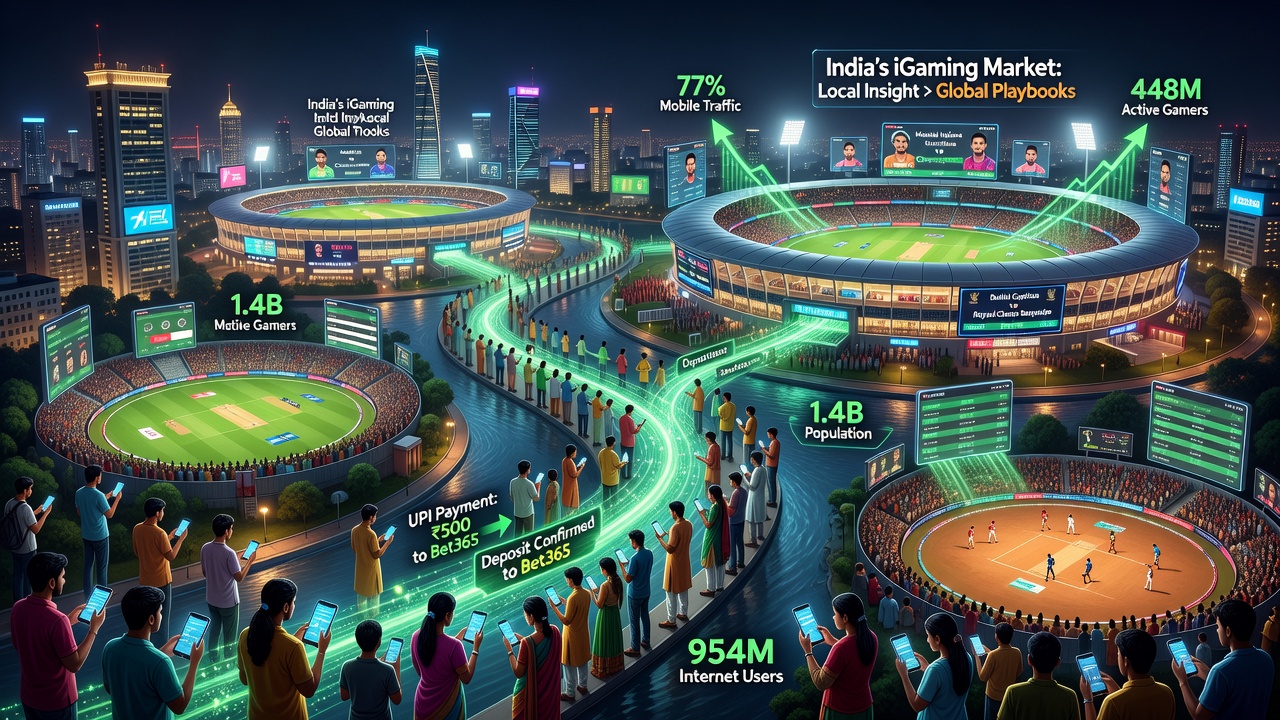
India presents a scale few markets can match: 1.4 billion people, 954 million internet users, and roughly 448 million with an active interest in gaming. Yet operators who assume this translates into an easy expansion target are misreading the country entirely. A new report from GR8 Tech, produced in partnership with iGB, argues that success in India depends less on capital and more on understanding local habits, payment rails, and a cultural relationship with cricket that shapes nearly every betting decision.
Cricket Is Not Just Popular, It's the Market Structure
The report's central finding is stark: the Indian Premier League generates more betting activity than matches involving the national cricket team itself. According to the data cited, cricket draws twenty bettors for every two who wager on football and one on kabaddi. That ratio signals something operators often underestimate - in India, product strategy cannot treat cricket as one sport among many. It functions as the market's organizing principle, dictating seasonal demand spikes, marketing calendars, and even how sportsbooks structure their odds and promotions around tournament windows.
A Mobile-First, Payment-Specific Market
Roughly 77% of online traffic in India originates from mobile devices, according to the report, making mobile optimization a baseline requirement rather than a competitive edge. Platforms built primarily for desktop use, or those that port over interfaces designed for European or Latin American users, tend to underperform. Payment behavior tells a similarly localized story: more than 90% of deposits flow through the Unified Payments Interface, India's real-time payment system. Operators without deep UPI integration are effectively locking themselves out of the majority of the addressable market, regardless of how competitive their product otherwise is.
Where the Revenue and Volume Actually Sit
Live casino content accounts for 56.4% of revenue, the report finds, while slots represent 47.5% of total betting volume - a gap that reflects differing player intent between high-frequency, lower-stake slot play and the engagement patterns typical of live dealer formats. Instant games such as Aviator and JetX are gaining traction quickly; Aviator alone reportedly makes up 21% of gross gaming revenue for one operator cited in the study. Meanwhile, skill-based formats - Teen Patti, Andar Bahar, and crash-style games - are drawing players who want an active role in outcomes rather than pure chance-based mechanics. None of these formats guarantee returns; they simply reflect shifting player preferences toward interactivity.
Fantasy Sports and the Regulatory Backdrop
Fantasy sports, particularly fantasy cricket, are projected in the report to generate ₹388 billion in revenue by 2026, underscoring how deeply cricket's popularity extends beyond traditional betting into adjacent product categories. This growth arrives alongside a regulatory environment that remains fragmented across India's states, with differing rules on what constitutes skill-based gaming versus gambling. For operators and platform providers, that patchwork means compliance strategy has to be regional, not national - a detail easily missed by companies used to operating under a single licensing framework.
Yevhen Krazhan, CSO at GR8 Tech, framed the report's purpose plainly: understanding India's market requires input from people who live its dynamics daily, not assumptions imported from elsewhere. For an industry often tempted by shortcuts, that is a useful corrective - India rewards patience and local grounding, not copy-paste expansion.