
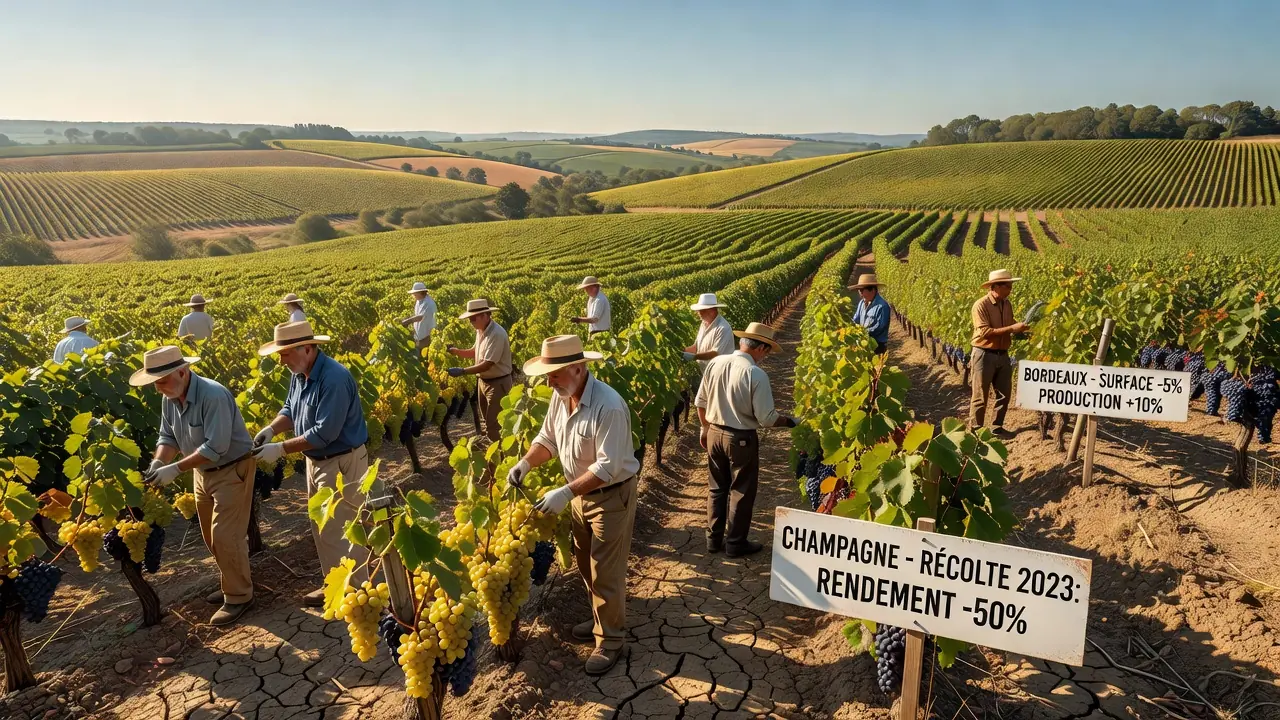
France's wine producers are bracing for one of the smallest harvests in decades after repeated summer heatwaves scorched vineyards across the country. According to estimates published Wednesday by the ministry of agriculture, total output will reach roughly 35 million hectolitres - down 2% on an already weak 2025 and 14% below the five-year average. The International Organisation of Vine and Wine has noted that last year's French production was already the lowest since 1957, underscoring how persistent this decline has become.
Heat, Smaller Vineyards, and an Uneven Map
The shortfall stems from a combination of factors: sustained high temperatures, only partially offset by recent rainfall, and a 1.9% reduction in cultivated vineyard area over the past year. But the headline number masks sharp regional contrasts. Some southern areas that suffered badly in 2025 have actually rebounded this year. Bordeaux, despite cutting its vineyard surface by 5%, expects a 10% production increase compared with 2025 - though still 11% below its 2021-2025 average. The south-west is seeing a similar recovery, with output up roughly 12%, close to its recent historical norm.
Champagne tells a different story. Growers there were forced into an unusually early harvest, which wrapped up in September for the first time on record, as extreme heat accelerated sugar accumulation in the grapes. Production fell by half compared with both last year and the five-year average. Claude Mandois, a Champagne producer, said he brought in about three-quarters of a normal yield by volume, but described the quality as exceptional "in terms of taste and visually." Burgundy and Beaujolais fared worse still, with production projected 30% below the five-year average.
Adaptation Is Becoming the Industry's Main Defense
Jérôme Despey, chair of the wine advisory board at FranceAgriMer and a winegrower in Hérault, described the disparity between regions as unlike anything he has seen. He pointed to changes in vineyard management - such as leaving more leaf cover to shield grapes from direct sun - as a reason southern vines have grown more resilient to repeated heat stress. May rainfall also gave southern regions an advantage that other regions lacked this season.
These adaptive practices matter beyond this year's numbers. They suggest an industry recalibrating its agronomic playbook in response to a climate pattern that is no longer treated as exceptional but as a recurring operational risk. Vineyard planning, canopy management, and planting density are increasingly shaped around heat tolerance rather than solely around traditional appellation conventions.
A Smaller but Healthier Crop
Despite the volume losses, both the ministry and industry bodies have emphasized the "excellent health" of this year's harvest. Dry, hot conditions suppressed the fungal and moisture-related diseases that often damage grape quality in wetter years. For an industry grappling with shrinking yields, that is a modest but genuine silver lining: less wine, but what exists is largely free of the rot and mildew problems that have afflicted past vintages.
The broader implication is structural. A sector built on centuries of regional tradition is now navigating a climate reality that rewards flexibility over convention. Whether this year's heterogeneous results - strong in Bordeaux, historically weak in Champagne and Burgundy - represent a temporary anomaly or the new shape of French viticulture will depend on how consistently these adaptive techniques can be applied across the country's diverse growing regions.