
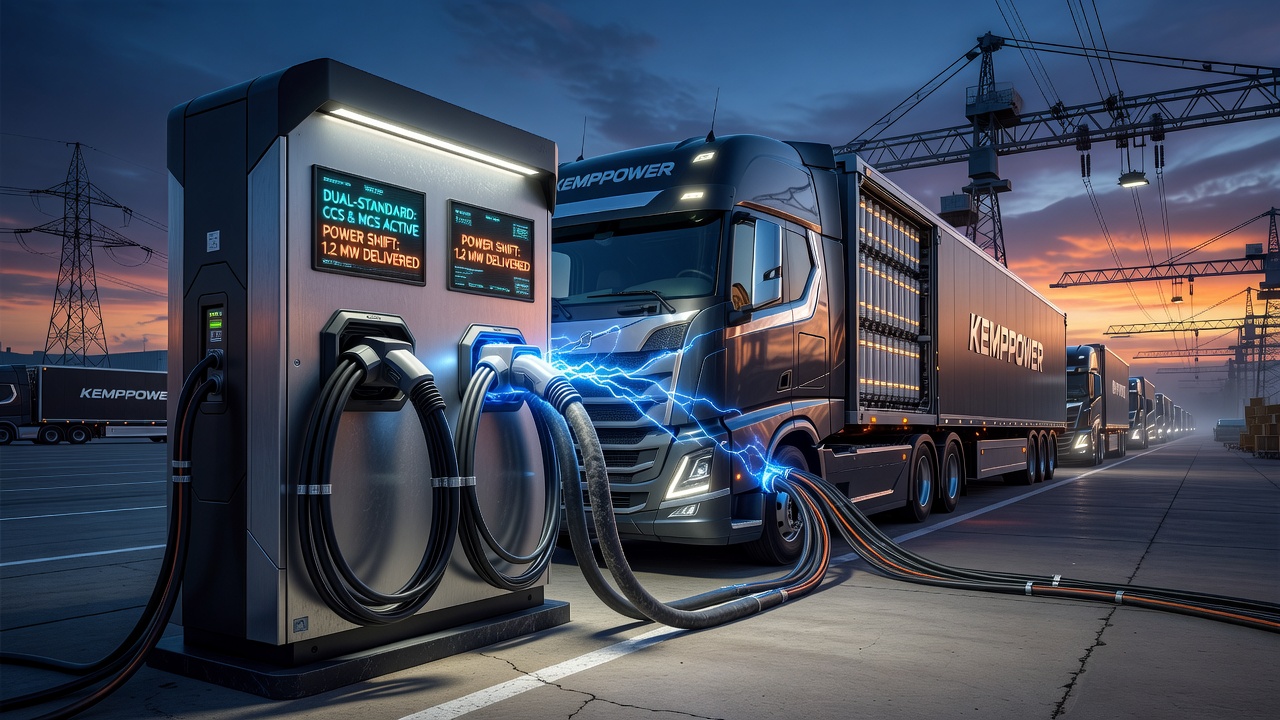
Kempower has unveiled the Mega Satellite Flex, a high-power charging dispenser that can serve both passenger EVs and heavy-duty electric trucks from the same unit. The charger supports the established Combined Charging System (CCS) at up to 560 kW, as well as the emerging Megawatt Charging System (MCS) at up to 1.2 MW, making it one of the first commercial products to bridge both standards in a single piece of hardware.
The announcement, made this week at the Advanced Clean Transportation Expo during Kempower's Unplug & Recharge event, arrives at a pivotal moment for the charging industry. CCS remains the dominant standard for cars and light-duty vehicles, but it was never designed for the power demands of long-haul electric trucks, which need to recharge large battery packs quickly to stay commercially viable. MCS is the industry's answer to that problem, and its rollout depends on infrastructure like this reaching the market. None of this works without robust underlying data and power-management systems, a principle not unlike how VPN encryption works to secure a connection regardless of which device or protocol is on the other end. how VPN encryption works
One Site, Two Charging Standards
The practical appeal of the Mega Satellite Flex lies in what it lets operators avoid: building and maintaining two separate charging installations for cars and trucks. Historically, a site owner wanting to serve both vehicle classes would need distinct hardware, separate power runs, and often duplicated permitting and construction costs. By combining CCS and MCS capability in one dispenser, Kempower is offering a way to serve mixed vehicle traffic from day one, deferring or eliminating a second capital investment down the line.
The specifications reflect the demands of both worlds. The unit supports up to 1,500 amps on the MCS side and 700 amps for CCS, with a 5-meter cable for CCS connections and a shorter 2.7-meter cable for MCS, reflecting the different vehicle geometries involved. An optional payment terminal is also available, positioning the charger for public and semi-public deployment rather than purely private fleet depots. The system is compatible with Kempower's existing distributed charging architecture, meaning operators already using the company's satellite-based setups can integrate the new unit without a full infrastructure overhaul.
Why Power Levels Matter
The jump from 560 kW to 1.2 MW is not incremental; it reflects a fundamentally different charging philosophy. Passenger EVs, even fast-charging 800-volt models, rarely need more than a few hundred kilowatts because their battery packs are comparatively small. Heavy-duty trucks carry batteries many times larger, and turnaround time is directly tied to freight economics. A charger capable of megawatt-level output can cut charging stops from hours to a timeframe closer to a fuel stop, which is the baseline heavy-duty fleets need before electrification becomes operationally competitive with diesel.
A Market Still Taking Shape
The Mega Satellite Flex is not expected to reach customers until July 2026, when it launches in North America and Europe. That timeline matters: MCS is still being finalized and adopted across truck manufacturers, and infrastructure providers are essentially building for a standard that is maturing in real time. Kempower's dual-standard approach hedges against uncertainty by letting operators serve today's vehicles while preparing for tomorrow's, rather than betting entirely on one protocol's pace of adoption.