
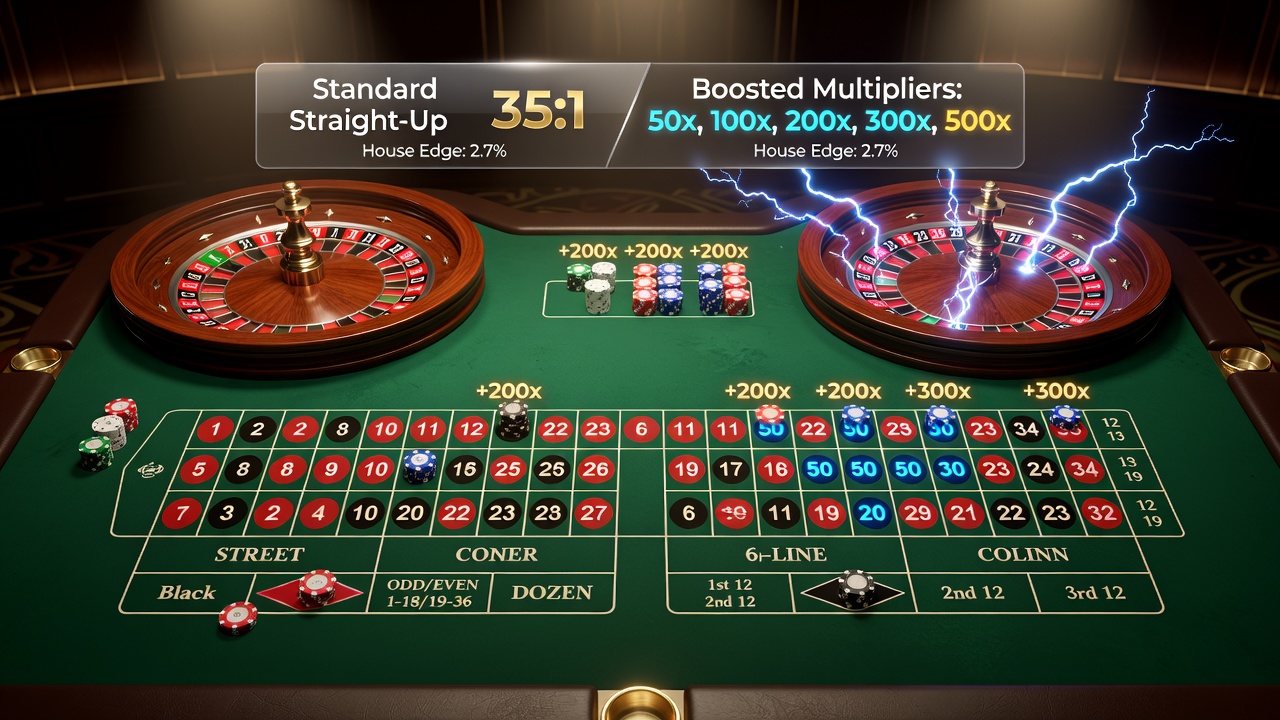
A single straight-up number bet on standard European roulette pays 35 to 1. On Lightning Roulette, that same bet can pay up to 500 to 1 - a payout jump that has nothing to do with luck and everything to do with a randomized multiplier system bolted onto an otherwise familiar wheel. That difference in payout structure is the entire story of why players either love this variant or avoid it entirely.
The confusion starts because Lightning Roulette looks like ordinary European roulette at first glance: same 37 pockets, same single zero, same wheel layout. But the moment the multipliers strike before each spin, the math underneath the felt changes completely. Anyone comparing the two games side by side needs to understand exactly where the rules diverge, because the house edge, the payout table, and the optimal betting approach are not interchangeable. For a detailed breakdown of how these two formats stack up against each other, this comparison of lightning roulette vs european roulette lays out the structural differences that most players never notice until they've already placed a bet.
This piece walks through the rules governing each game, the odds that actually apply once multipliers enter the picture, and the payout tables side by side. It also covers what a sound betting approach looks like once you accept that Lightning Roulette is a higher-variance cousin of the classic game rather than a reskin of it.
What Is Lightning Roulette and How Does It Differ from Standard Roulette
Lightning Roulette is a live dealer game built on the European roulette wheel but layered with a random number generator that strikes between one and five numbers on the board before every spin, assigning each a multiplier between 50x and 500x. If the ball lands on one of those struck numbers and a player has placed a straight-up bet on it, the payout multiplies accordingly. This is the defining mechanical difference from every other roulette variant on the market.
The Core Mechanics Behind the Multiplier System
Before the wheel spins, a random number generator - separate from the physical wheel - selects up to five numbers and assigns multipliers ranging from 50x to 500x. These numbers are announced with a lightning-strike animation, which is purely presentational but signals to players which numbers carry inflated payouts for that round. The wheel then spins independently, meaning the struck numbers have no higher physical chance of hitting; they simply pay more if they do.
Wheel Layout and Physical Setup
The physical wheel matches standard European roulette exactly: 37 pockets numbered 0 through 36, a single green zero, and the same alternating red-and-black color scheme. There is no American-style double zero, which already puts this game ahead of American roulette in terms of raw odds before any multiplier is even considered.
Why the Multiplier Doesn't Change the Wheel's Physics
A common misconception is that struck numbers become "hot" or more likely to hit. They are not. The RNG multiplier selection and the physical ball drop are entirely independent processes, so the probability of any given number hitting remains fixed at 1 in 37 regardless of whether it carries a multiplier that round.
European Roulette Rules Explained
Understanding european roulette rules is the foundation for understanding Lightning Roulette, since the latter borrows the former's entire betting structure and simply adds a payout layer on top. European roulette uses a single-zero wheel, which is the single most important rule distinction from its American counterpart.
Basic Bet Types and Table Layout
Players can place inside bets - straight-up, split, street, corner, and six-line - directly on the number grid, or outside bets - red/black, odd/even, high/low, dozens, and columns - on the surrounding sections of the layout. Each bet type carries a distinct probability and payout ratio, and understanding this relationship is essential before adding any multiplier variant into the mix.
The Single Zero Advantage
Because European roulette has only one zero pocket instead of two, the house edge sits at 2.7%, roughly half of what American roulette offers. This single rule difference is why serious players default to European tables whenever given the choice.
La Partage and En Prison Rules
Some European tables offer additional rules - la partage returns half a losing even-money bet if the ball lands on zero, while en prison holds the bet for another spin instead. Neither rule is universal, so players should confirm table-specific terms before assuming they apply. These rules, when present, lower the effective house edge on even-money bets to around 1.35%.
- Straight-up bet: single number, highest payout, lowest probability
- Split bet: two adjacent numbers
- Street bet: three numbers in a row
- Corner bet: four numbers meeting at a point
- Six-line bet: two adjacent rows
- Outside bets: red/black, odd/even, high/low, dozens, columns
Roulette Odds and Payouts Compared
The relationship between roulette odds and payouts is where the real analytical work happens, because a payout table alone tells you nothing about long-term expected value without factoring in the actual probability of each outcome.
Standard European Roulette Payout Table
A straight-up bet pays 35 to 1 with a true probability of 1 in 37, giving the house its 2.7% edge. Split bets pay 17 to 1, street bets pay 11 to 1, corner bets pay 8 to 1, and six-line bets pay 5 to 1. Outside bets like red/black or odd/even pay even money, 1 to 1, with roughly 48.6% probability of winning on any given spin.
Lightning Roulette Payout Table
Straight-up bets on non-struck numbers pay the standard 35 to 1. Struck numbers pay according to their assigned multiplier: 50x, 100x, 200x, 300x, or the rare 500x. Outside and other inside bets remain unaffected by the multiplier system entirely - only straight-up numbers qualify for the lightning payout boost.
How the House Edge Shifts Between Formats
Lightning Roulette carries a higher house edge on straight-up bets - typically around 13% to 15% depending on the specific multiplier distribution used by the operator - compared to the standard 2.7% on regular European roulette straight-up bets. This is the trade-off for the chance at a 500x payout: the game compensates for those rare massive wins by trimming payouts on numbers that don't strike, which actually pay slightly less than 35 to 1 in the base version of the game to fund the multiplier pool.
European Roulette Comparison: Lightning vs Standard vs American
Placing all three variants next to each other clarifies exactly what a player gains or sacrifices with each choice.
Wheel Structure and Zero Count
Standard European and Lightning Roulette both use a single-zero, 37-pocket wheel. American roulette uses a 38-pocket wheel with both a single and double zero, pushing its house edge to 5.26% - nearly double that of European variants on standard bets.
Payout Volatility and Variance
Standard European roulette offers steady, predictable payouts with lower variance. Lightning Roulette introduces significant variance through its multiplier system - most spins yield ordinary payouts, but the occasional 500x hit can dramatically swing session results. American roulette offers no such multiplier mechanic and simply carries a worse baseline house edge across the board.
Suitability for Different Player Profiles
Conservative players seeking predictable, lower-variance sessions tend to prefer standard European roulette. Players chasing bigger, rarer wins with entertainment value baked into the multiplier animation gravitate toward Lightning Roulette. American roulette rarely wins this comparison on odds alone and is typically chosen only when no European table is available.
Lightning Roulette Strategy: Practical Approaches
No betting system changes the underlying probability of any roulette outcome, but a coherent lightning roulette strategy can manage bankroll exposure and align bet selection with a player's risk tolerance.
Betting on Outside Bets to Reduce Variance
Because multipliers only apply to straight-up numbers, players who prioritize steadier returns often lean on outside bets - red/black, odd/even, high/low - which behave identically to standard European roulette and carry the same 2.7% house edge. This approach essentially ignores the multiplier feature and treats the game as ordinary roulette with entertaining visuals.
Chasing Multipliers with Straight-Up Bets
Players who want a shot at the 500x payout need to place straight-up bets and accept the elevated house edge that comes with it. A disciplined approach here means setting a fixed number of spins per session and a strict loss limit, since chasing multiplier hits over long sessions compounds the higher edge against the player.
Bankroll Management Specific to Lightning Roulette
Given the increased variance, bankroll allocation should be more conservative per spin than in standard roulette. A common practical guideline is risking no more than 1% to 2% of total bankroll on any single straight-up bet, reserving larger portions for even-money outside bets if the goal is session longevity rather than a single large payout.
Combining Bet Types for Balanced Exposure
Some players split their stake between a handful of straight-up numbers and a covering outside bet, aiming to capture occasional multiplier upside while cushioning the downside with steadier even-money returns. This hybrid approach doesn't beat the house edge, but it does smooth out the emotional volatility of watching straight-up bets miss repeatedly.
Choosing the Right Game for Your Playing Style
The decision between Lightning Roulette and standard European roulette ultimately comes down to what a player values: consistency or upside potential.
When Standard European Roulette Makes More Sense
Players who prioritize a lower house edge and predictable session outcomes should default to standard European roulette, particularly on tables offering la partage or en prison rules. The math is simply more favorable across the board for anyone not specifically chasing large multiplier wins.
When Lightning Roulette Is the Better Fit
Players drawn to entertainment value, live dealer presentation, and the rare chance at outsized payouts will find Lightning Roulette more engaging, provided they accept the trade-off in house edge on straight-up bets. It suits shorter, higher-energy sessions rather than long grinding play.
Testing Both Before Committing Bankroll
Because both games are widely available at live casino platforms, testing each with small stakes before committing to a long session strategy is a practical way to gauge personal comfort with the variance each format introduces.
Frequently Asked Questions
Does the lightning multiplier increase my chance of winning?
No. The multiplier only affects the payout size if a struck number hits, not the probability of it hitting. Every number on the wheel still has the same 1-in-37 chance regardless of whether it carries a multiplier that round.
Is the house edge the same on every bet type in Lightning Roulette?
No. Outside bets and non-straight-up inside bets carry the same house edge as standard European roulette, around 2.7%. Straight-up bets carry a higher edge, typically in the 13% to 15% range, because part of the payout structure funds the multiplier system.
Can I use the same betting system on Lightning Roulette that I use on standard roulette?
Systems based on outside bets, such as red/black progressions, transfer directly since those bets behave identically in both games. Systems built around straight-up number coverage need adjustment because the payout math and house edge differ significantly.
Why does European roulette have better odds than American roulette?
European roulette uses a single zero pocket, giving it 37 total pockets and a 2.7% house edge. American roulette adds a second zero pocket, bringing the total to 38 and raising the house edge to 5.26%, nearly double the European figure.
What's the maximum payout possible on a single spin of Lightning Roulette?
A straight-up bet on a number struck with the highest available multiplier can pay up to 500 to 1, compared to the standard 35 to 1 payout on regular European roulette straight-up bets.
Should beginners start with Lightning Roulette or standard European roulette?
Beginners generally benefit from learning standard European roulette first, since its payout structure is simpler and more predictable. Once comfortable with basic bet types and odds, transitioning to Lightning Roulette becomes easier to understand and manage responsibly.