
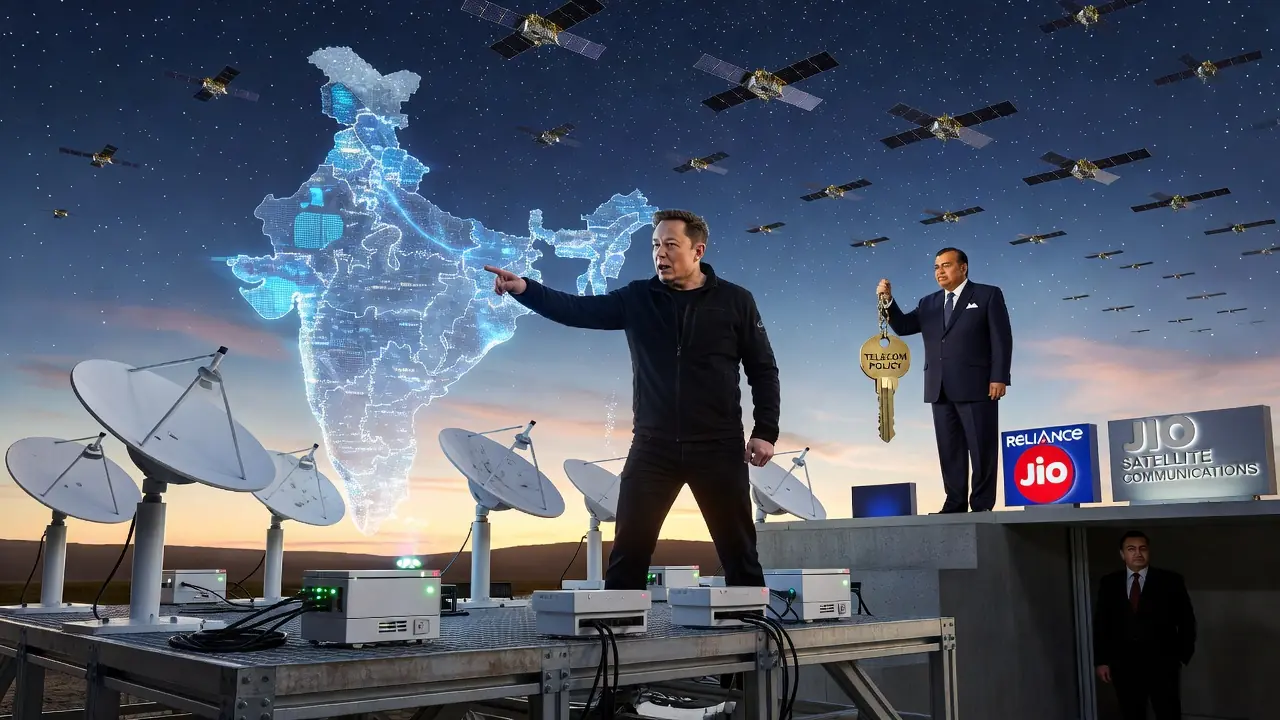
Elon Musk has publicly questioned whether Mukesh Ambani, India's richest man, wields more influence over telecom policy than the government itself. The remark, posted on X, followed days of escalating tension between SpaceX's satellite internet arm, Starlink, and Indian authorities over the final licensing steps needed to launch commercial service. India has rejected the claim, insisting its satellite spectrum framework applies equally to every applicant.
A Five-Year Wait for Final Clearance
Starlink has pursued entry into India since 2021 and has already secured key preliminary licences. What remains outstanding are security clearances and spectrum allocation - steps the government says apply equally to Starlink, Eutelsat OneWeb, and Jio Satellite Communications, the Reliance-backed rival. According to India's Ministry of Communications, all three operators sit at broadly the same stage of approval. Musk disputes that framing, noting Starlink already operates legally in more than 165 countries and arguing the delay has no technical justification.
Competitor or Partner? The Ambani Contradiction
The dispute is complicated by an inconvenient detail: Starlink has commercial agreements with the very companies Musk has accused of blocking it. In March 2025, both Reliance Jio and Bharti Airtel signed deals with SpaceX to distribute Starlink hardware and services in India, pending regulatory sign-off, with both sides floating possible network-sharing arrangements. That makes Musk's public accusation against Ambani unusual - he is simultaneously a prospective business partner and, in Musk's telling, a gatekeeper obstructing fair competition. Reliance Jio, through its chairman Akash Ambani, has declined to engage with the allegation directly, saying only that the company remains focused on delivering value to Indian consumers. Bharti Airtel has said its own satellite venture is likewise awaiting government approval.
Security Concerns and Market Stakes
Security clearance has become the central friction point. Indian authorities have twice linked recovered Starlink equipment to sensitive incidents - a drug-smuggling investigation in the Andaman and Nicobar Islands and a military operation in Manipur - though Musk maintains the company's network was never actually active in India at the time, meaning the hardware found could not have been transmitting through Starlink's system. SpaceX executives have said the company has spent years building security controls into its architecture specifically to satisfy Indian regulatory demands.
Beyond the political theatre, the commercial stakes are substantial. India remains one of the world's largest internet markets, yet rural and remote regions still lack reliable broadband or mobile coverage. Satellite internet is pitched as a fix for that gap, but affordability is an open question. Starlink has not published Indian pricing, and its US residential plans start around $55 a month - a figure that would place the service out of reach for large segments of the Indian population if replicated without adjustment. Whether Starlink, Jio, and Airtel compete head-to-head or end up sharing infrastructure, the outcome will shape how - and for whom - satellite connectivity actually becomes accessible in the country.