
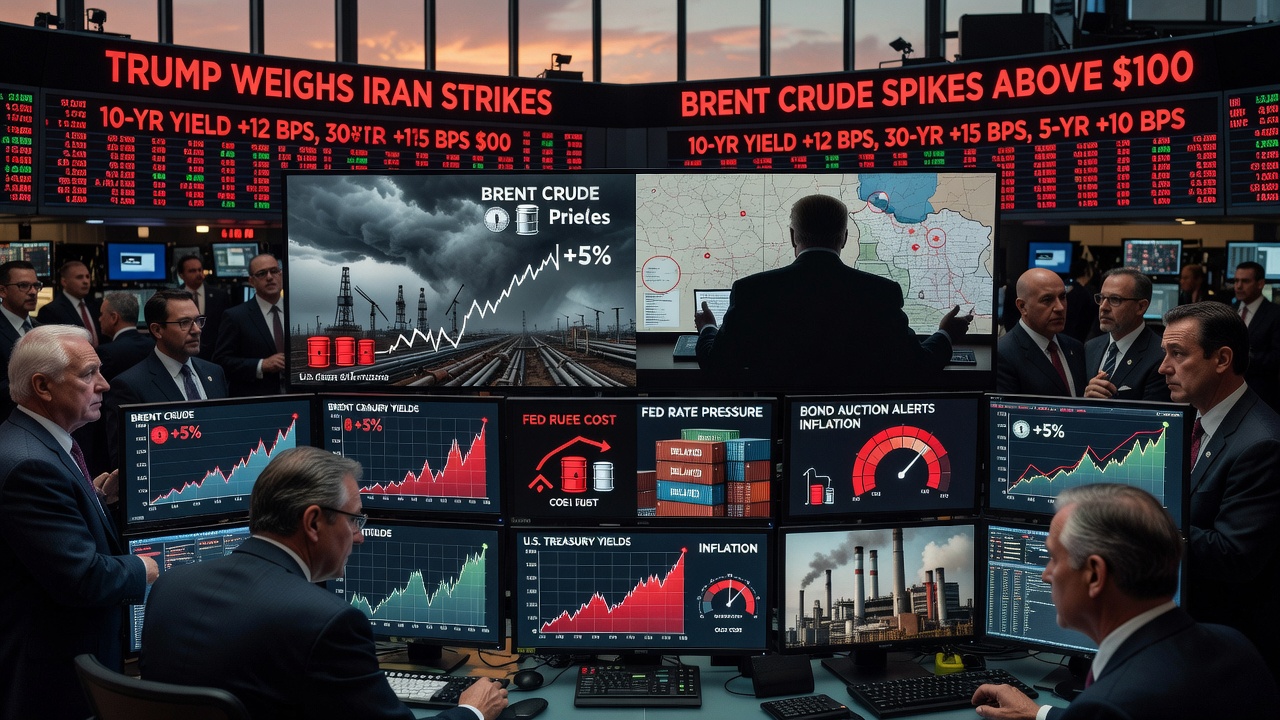
Bond markets moved sharply on Thursday after a report from The Atlantic suggested President Trump is weighing military strikes against Iran ahead of the midterm elections, a possibility that pushed Brent crude back above $100 a barrel and sent yields on the 10-year, 30-year, and 5-year Treasuries higher. The combination of geopolitical risk and rising energy prices is forcing investors to reassess how much more pressure the bond market can absorb, even as the Treasury tries to manage a heavy slate of debt auctions.
Why Oil and Yields Are Moving Together
Energy prices and interest rates are connected through inflation expectations. When crude jumps 5% in a single session, as it did this week, traders anticipate higher costs feeding through fuel, shipping, and manufacturing, which in turn pressures the Federal Reserve to keep rates elevated for longer. That expectation shows up almost immediately in Treasury yields, particularly at the long end of the curve, where investors demand more compensation for holding debt over a longer horizon amid uncertain inflation outcomes.
The timing matters. A potential military escalation in the Middle East introduces a level of unpredictability that markets generally price in quickly and painfully, since oil supply disruptions have historically been one of the fastest channels through which geopolitical conflict reaches household budgets and corporate balance sheets.
The Treasury's Balancing Act
Even before this latest shock, the Treasury was navigating a delicate auction calendar. A 10-year auction priced earlier in the week found reasonably strong demand, with buyers willing to lock in yields near 5.3%, a sign that some fixed-income investors view current rates as an attractive entry point for steady income, especially when other asset classes look shakier. A 30-year auction worth $22 billion followed, alongside a Treasury buyback operation targeting debt in the 20- and 30-year range.
Buybacks are meant to smooth market functioning by removing less liquid, older bonds from circulation, but the scale involved, a few billion dollars, is modest next to the trillions in outstanding federal debt. That raises a fair question about how much real effect these operations have versus serving as a signal of the Treasury's intent. There is no obvious better alternative on the table right now, whether that means buying back more aggressively, slowing the pace of federal borrowing tied to capital spending, or simply letting the market absorb higher rates over time.
A Market That Isn't Moving Together
Beneath the yield story sits a separate concern about how narrow the stock market's recent gains have been. Technology shares have risen roughly 5.6% over the past month, but sectors including communications, healthcare, energy, industrials, consumer discretionary, and financials have moved in the opposite direction, with some down more than 7%. That divergence, often described as poor market breadth, suggests the rally is concentrated in a handful of names rather than reflecting broad economic confidence.
It is worth remembering that communications services, as a sector classification, includes major technology names such as Meta, which complicates any simple reading of "tech versus everything else." The practical takeaway is that higher yields are not hurting all parts of the market equally, and investors chasing index-level gains may be exposed to more concentration risk than the headline numbers suggest.
What to Watch Next
Thursday's 30-year auction, scheduled for early afternoon, will offer another read on investor appetite for long-dated government debt at a moment of heightened geopolitical tension. If demand falters the way some have anticipated given the backdrop, yields could climb further, adding pressure to equity valuations already dependent on a narrow set of winners. Markets will also be watching whether reports about Iran escalate into policy action or fade, since oil's trajectory from here depends heavily on which way that story breaks.