
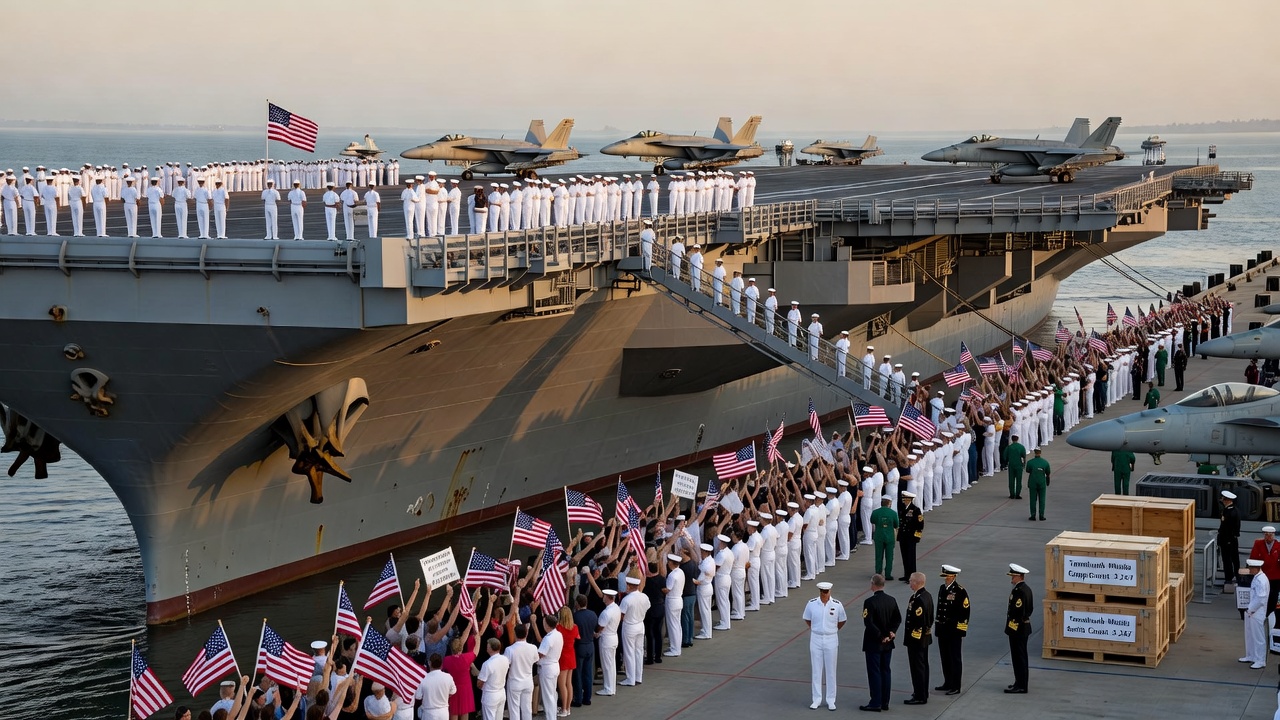
The USS Abraham Lincoln pulled back into San Diego after nearly ten months away, closing out one of the most demanding deployments the Navy has fielded in recent memory. For more than 260 consecutive days, the carrier and its strike group operated without a single port call, a stretch of sustained seagoing duty that military officials say reflects the operational tempo required to support U.S. action against Iran.
A Deployment Defined by Endurance
Carrier strike groups are built for distance and persistence, but 260-plus days without touching land is an outlier even by Navy standards. Extended deployments of this length are typically driven by geopolitical necessity rather than routine scheduling. Defense Secretary Pete Hegseth detailed the scope of the mission, citing thousands of combat sorties flown from the Lincoln's deck and hundreds of Tomahawk missile launches carried out during the operation. Those figures illustrate a carrier functioning less as a forward presence and more as an active combat platform for the better part of a year.
Missions at this scale place enormous strain on aircraft, munitions supply chains and maintenance crews, all of which must function continuously at sea without the resupply flexibility a port call provides. Every additional week away from shore compounds fatigue across flight operations, engineering and logistics teams alike.
The Human Cost Behind the Mission
Beyond hardware and sortie counts, the deployment exposed a harder reality: the psychological toll on sailors. The Navy disclosed eight suicide attempts among crew members of the carrier strike group during the deployment, a figure that underscores how prolonged separation, confined living conditions and relentless operational demands can erode mental health even among trained personnel.
Military mental health specialists have long flagged extended deployments as a risk factor for psychological distress, given the combination of isolation, disrupted sleep cycles, high-stakes decision-making and limited access to family support. A near ten-month stretch without a port call removes one of the few release valves sailors typically rely on: time ashore to decompress, communicate more freely with loved ones and reset before returning to duty.
Strategic Stakes Beyond the Flight Deck
The Lincoln's deployment did not happen in isolation. It unfolded against a wider U.S.-Iran confrontation that has rippled through regional security arrangements and global energy markets, where tensions in the Gulf routinely influence oil pricing and shipping insurance costs. A carrier strike group operating at this intensity signals sustained military commitment to deterrence in the region, and its presence - or eventual withdrawal - carries weight well beyond naval circles.
Returning to San Diego does not mean the broader mission has concluded. Other assets will continue covering the operational gap the Lincoln leaves behind, and the strategic calculus driving U.S. posture in the region remains unchanged. What has ended, for now, is one carrier's chapter in a conflict whose resolution is still uncertain.
What Comes Next for the Crew
For the thousands of sailors aboard, homecoming marks the start of reintegration - reconnecting with families, readjusting to life on land and, for some, processing the psychological weight of a deployment that pushed endurance limits. Naval support systems, including counseling and family readiness programs, typically scale up after deployments of this length, though the reported suicide attempts suggest existing resources may need closer scrutiny as the Navy reviews how it manages extended, high-intensity deployments going forward.